« BACK TO BLOG
Market Intel, Forecasts & Strategies
In Atlanta and Across the Southeast, Office Buildings Are Selling to the Businesses That Occupy Them
This article was written by Steve Marcinuk and originally published by KeyCrew Journal on October 5, 2026. It features insight from Michael Bull, CCIM, founder of Bull Realty.
The conventional wisdom on office real estate has settled into a familiar narrative: remote work gutted demand, lenders want out, and the asset class is in long-term decline. But transaction data from at least one active Southeast brokerage tells a different story, one where the buyers showing up are not institutional investors bottom-fishing for distressed assets, but the businesses that actually need the space.
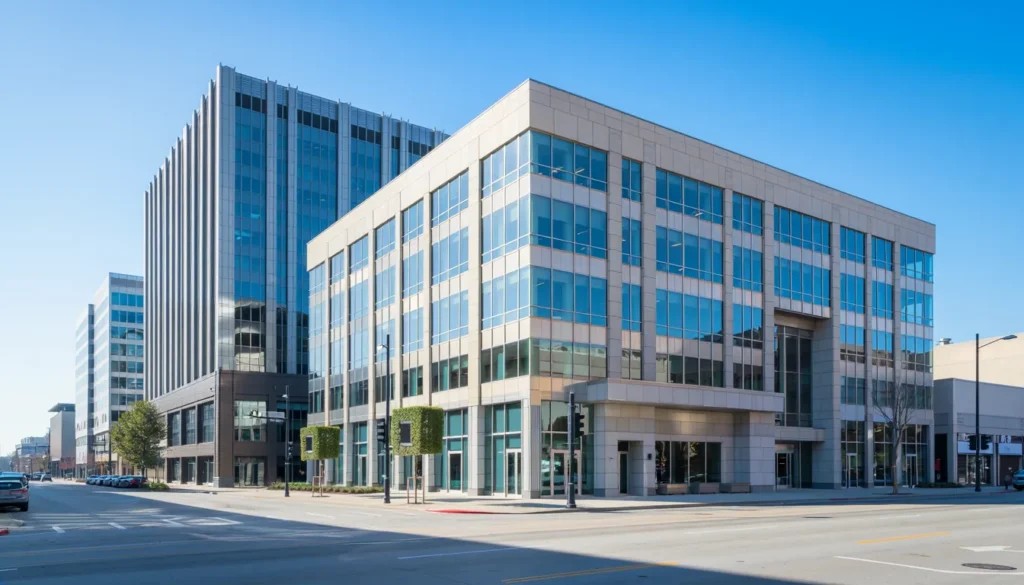
Michael Bull, a commercial real estate broker with 40 years in the industry and founder of Bull Realty in Atlanta, says the last seven larger office buildings his firm brought to market, ranging from roughly 20,000 to 200,000 square feet, were all won by partial users, not pure investors. Investors made offers, but occupiers outbid them every time.
The pattern makes practical sense. A business buying its own building eliminates leasing commissions, fills vacancy immediately, and controls its environment. Many of these buyers did not set out to become real estate investors, according to Bull. They wanted to stop annual occupancy costs from climbing or to control the space they worked in. “A lot of times when I ask them about it, they say, ‘When I bought this building, I did it kicking and screaming. I didn’t really want to invest in real estate,'” Bull says.
Why Supply Dynamics Favor Buyers Right Now
Bull’s broader thesis on office rests on a structural argument about supply. He says more office space is currently being torn down or converted in the U.S. than is being built, a dynamic he describes as the first time in history that total office square footage has been depleting. In markets with job and population growth, he argues, reduced supply does not take long to shift the balance.
The pricing reflects that imbalance. Bull says he is about to bring a 17-story office tower to market at $64 per square foot, and another building in Buckhead – a well-established area of Atlanta – at $160 per square foot. He estimates those buildings would cost around $700 per square foot to build today. “You give it some time with the demand coming back, and it’s going to be hard to lose,” he says.
He draws a parallel to previous cycles. Apartments were declared dead in the late 1980s; contrary investors who bought after that crash became wealthy. Retail was written off after the dot-com bust as over-built and obsolete, it is now one of the strongest commercial asset classes. “When you’re looking at it in that time period, it looks like doom and gloom for a long, long time,” Bull says. “And that’s just because we’re human.”
The Case for Buying Bigger Than You Need
For business owners considering an acquisition, Bull identifies a common mistake: buying too small. Users tend to calculate their current square footage needs precisely and purchase to fit. The problem is that businesses either grow and outgrow the space, forcing a sale or lease of a building they own – or they start the search process too late and end up rushed.
Bull advises buying something with room to expand and renting out the unused portion in the interim. The alternative, owning a building you cannot grow into, creates the exact kind of operational problem the purchase was supposed to eliminate.
He also notes that the financial payoff for user-buyers tends to arrive as a surprise. Owners focus on running their business day to day, and years pass. Between inflation pushing values up, rents rising, and principal being paid down on the loan, they accumulate equity they never planned for. “Now I’ve got this windfall that I didn’t even think about because my business was occupying the space,” is how Bull summarizes what owners have told him over the years.
Bull experienced this himself. When he started Bull Realty 28 years ago, he bought a building and used a small part of it. Over time, he occupied more and more of the space until the business outgrew it entirely. He moved to a larger building but still owns the original property.
Office Quality Is Improving, Not Just Repricing
Beyond pricing, Bull argues that the office environment itself has gotten better as a result of the disruption. Employers have had to make workplaces people actually want to be in, with better amenities, healthier environments, and stronger locations. He describes his own office as having fresh-cut flowers, plants, good views, a fitness center, and covered parking.
He sees remote work gradually losing its hold. “A lot of people are realizing that even for mental issues, they want to get out of the house and have a different place to go,” he says. In his view, returning demand is not driven solely by employer mandates but also by individual preference shifting back toward in-person work.
Bull cautions that buyers should still do careful research, particularly on Class B and C office buildings, where the recovery is less established than in trophy and Class A space. But he expects the trend to reach those tiers as lower-quality stock continues to be removed through demolition and conversion, gradually tightening supply across quality levels. “You want to watch what you buy,” he says, “but in markets where you do have population and job growth, you’re going to see that demand come back.”
For business owners who currently lease office space, Bull’s message is direct: this is the window to buy. Prices per square foot sit at a fraction of replacement cost, occupiers are consistently outbidding investors, and the supply pipeline is not refilling. The owners who benefit most, based on his experience, are those who buy with room to grow, even if the purchase feels premature.
About the Expert: Michael Bull is a commercial real estate broker and founder of Bull Realty in Atlanta, Georgia.
This article is based on information provided by the expert source cited above. It is intended for general informational purposes only and does not constitute legal, financial, or real estate advice. Readers should conduct their own research and consult qualified professionals before making any real estate or financial decisions.
Originally published in KeyCrew Journal by Steve Marcinuk. All rights belong to KeyCrew. View the original article on KeyCrew Journal »
Have a Commercial Real Estate Strategy to Discuss?
With more than $8 billion in closed commercial real estate transactions, Michael Bull, CCIM, brings extensive transaction and market expertise to owners, investors, and companies across the United States. As host of America’s Commercial Real Estate Show and an active commercial real estate broker with a strong presence in Atlanta and markets throughout the Southeast, Michael offers experienced perspective on property strategies, market conditions, acquisitions, dispositions, and other commercial real estate opportunities.
Contact Michael to discuss your commercial real estate objectives.
Michael Bull, CCIM
Michael@BullRealty.com
404-876-1640 x 101